Active R&D initiative

Wingspan Command Center

A developing operating environment for coordinating governed AI-assisted work while keeping authority, evidence, and human responsibility visible.

Purpose

Researching the operating layer around capable agents.

Wingspan Command Center explores what happens after an organization moves beyond a single AI conversation and begins coordinating specialized agents, recurring work, evidence, approvals, and handoffs.

The initiative focuses on practical operating questions: who owns the work, what an agent is allowed to do, which source supports a claim, when independent review is needed, and how a task closes without losing accountability.

Working prototype

See the working prototype

This 2:45 demonstration shows the Wingspan Command Center in a fictional, disconnected judge workspace. Kevin Hintzman narrates how the interface brings outcomes, direct agent work, decisions, evidence, roundtables, and usage into one visible operating view.

The video demonstrates the interface and the questions behind it. It does not establish production readiness, customer use, native-platform parity, accessibility or security conformance, or a guarantee that AI-assisted work will be correct or safe.

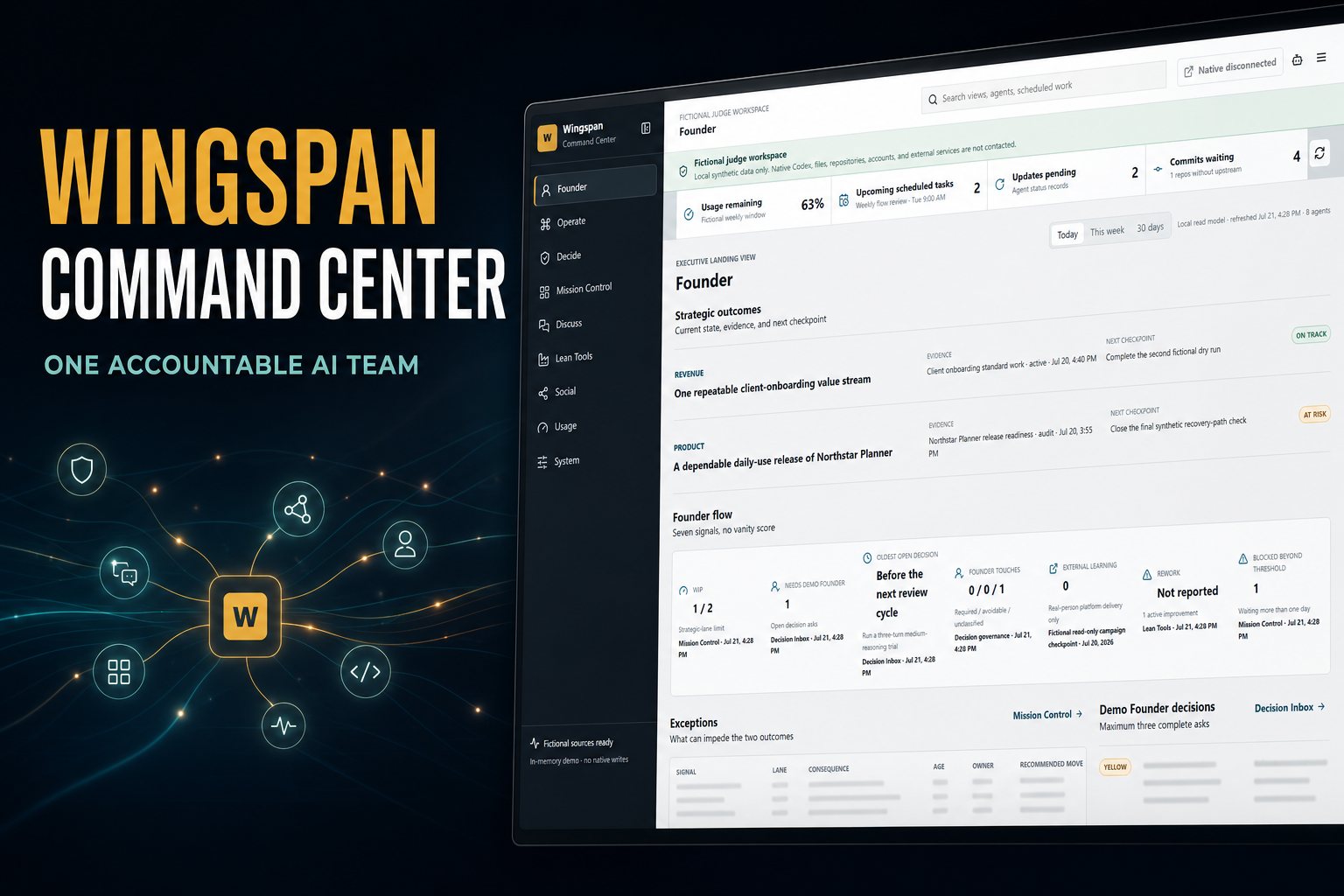
Text reads, ‘Wingspan Command Center’ and ‘One accountable AI team.’ Beside it, a laptop displays the Founder view of a fictional judge workspace with strategic outcomes, evidence, checkpoints, and a visible banner stating that native systems are disconnected.

Wingspan Command Center demonstration · 2 minutes 45 seconds · Founder narration

Submitted to OpenAI Build Week. Submission does not imply selection, award, endorsement, or partnership.

Why it exists

Using multiple AI agents can increase throughput while quietly increasing coordination cost. Work becomes spread across tasks, approvals lose context, usage becomes difficult to compare, and a founder can spend more time relaying status than making decisions. Wingspan Command Center explores an interface that makes agent work easier to see without becoming another source of truth.

What the demonstration shows

  • Founder begins with strategic outcomes, exceptions, source freshness, and complete human decisions.
  • Operate preserves direct one-to-one task continuity and distinguishes a new turn from steering active work.
  • Decide records the choice, consequence, owner, timing, approval stage, and delivery receipt.
  • Mission Control keeps work, ownership, progress, evidence, and source-control review visible.
  • Discuss keeps specialist positions attributed, preserves dissent, and records the owner and next test.
  • Usage separates model, reasoning, speed, token demand, and provider limits before any bounded trial.

How it was built

The interface uses React, Vite, Express, and a replaceable local runtime adapter. Codex with GPT-5.6 Sol helped implement and test durable operating state, direct task conversations and recovery, decision receipts, attachments and diff review, native handoff controls, four simultaneous roundtable rooms, the isolated judge adapter, and repeatable source-lock verification. Kevin retained the product, governance, and approval decisions.

The public demonstration uses fictional sample data and an isolated in-memory adapter. It does not contact native Codex, local files, repositories, accounts, or external services.

What the work taught us

Agent orchestration is primarily a visibility and authority problem. A polished summary is not enough: people need continuity, timestamps, explicit ownership, reliable delivery, evidence provenance, visible limits, and an easy path back to native tools.

Read the full public project story on Devpost (opens in a new tab)

Read the complete demonstration transcript

0:00–0:22 · The problem

AI agents can do serious work, but coordinating many tasks creates a new problem: status is scattered, approvals are hard to trace, usage is opaque, and group discussions can become manual relay work. Wingspan Command Center turns those separate tasks into one visible operating system.

0:22–0:43 · Executive clarity

The Founder view starts with outcomes, not activity. It shows what is moving, what is held, and exactly what needs a human decision. Completed work stays out of the attention queue, and every signal preserves its source and freshness.

0:43–1:04 · Direct agent work

Operate preserves direct one-to-one agent conversations. This judge build uses an isolated in-memory task runtime, so the response is deterministic and fictional, but the interaction contract matches the production interface: task continuity, timestamps, steer-versus-new-turn behavior, and jump-to-latest navigation.

1:04–1:25 · Decisions with boundaries

Decide turns a recommendation into a complete decision: the exact choice, consequence of waiting, needed-by point, audit stage, and actions still held. An approval is a traceable receipt, not a magic bypass around security, legal, or production gates.

1:25–1:42 · Multi-agent discussion

Discuss supports multiple roundtable rooms and any number of invited agents. Responses remain attributed, dissent stays visible, and one synthesis identifies the recommendation, disagreement, owner, and next test.

1:42–2:02 · Usage optimization

Usage separates model, reasoning, speed, token demand, and provider-wide credit limits. The optimization monitor waits for comparable evidence, then recommends a bounded trial that can be manually accepted, automatically limited, and reverted if quality drops.

2:02–2:33 · Judge safety and build story

This package is safe to test: every record is fictional, every mutation is in memory, and native tasks, files, repositories, accounts, and external services are disconnected. In the primary Codex task, GPT-5.6 Sol helped implement and test the durable state, chat lifecycle, decision receipts, recovery, and four-room roundtables, while the founder set the product and approval boundaries.

2:33–2:45 · Close

Wingspan Command Center makes an AI team easier to direct, easier to audit, and easier to leave when the native tools are the better fit.

Research questions

What the initiative is examining

These are working questions, not claims that every problem has been solved.

Continuity without authority drift

How can useful context carry forward while permissions, decisions, and execution ownership remain explicit?

Evidence that survives handoffs

How can source custody, findings, assumptions, and unresolved questions remain inspectable when work changes hands?

Clear human decision points

Where must a person review, approve, correct, or stop work rather than letting automation imply authority?

Current status and boundaries

An internal R&D environment—not a finished product.

Wingspan Labs is using the Command Center to test operating methods and document lessons. It is not currently offered as public software, a certification, a compliance system, or a guarantee that AI-assisted work will be correct or safe.

Public descriptions intentionally exclude private operating instructions, credentials, customer or applicant information, and internal control details. People remain responsible for judgment, approvals, professional advice, and consequences.